What is the AI Risk Management Framework and who is it for?
It is a voluntary, rights-preserving, non-sector-specific, use-case-agnostic resource from NIST that helps organizations designing, developing, deploying, or using AI systems manage AI risks and promote trustworthy and responsible AI.
The Framework was developed under the National Artificial Intelligence Initiative Act of 2020 and is meant to equip AI actors, defined as those playing an active role in the AI system lifecycle, with approaches that increase the trustworthiness of AI systems over time. It is designed to be practical, flexible across sectors and organization sizes, and to adapt as AI technologies evolve.
How does the Framework define AI risk?
Risk is the composite measure of an event's probability of occurring and the magnitude or degree of its consequences, where impacts can be positive, negative, or both, yielding opportunities or threats.
When considering negative impacts, risk is a function of the magnitude of harm that would arise if an event occurs and the likelihood of occurrence, and harm can be experienced by individuals, groups, communities, organizations, society, the environment, and the planet. Risk management is defined as coordinated activities to direct and control an organization with regard to risk.
Why are AI risks considered different from traditional software risks?
AI systems are socio-technical, may be trained on data that changes in hard-to-understand ways, and are complex enough that detecting and responding to failures is difficult, making their risks unique relative to ordinary software.
Appendix B catalogs AI-specific risks that are new or increased, including training data that may misrepresent its context, drift and staleness of datasets, massive scale with billions or trillions of decision points, higher statistical uncertainty and bias-management issues from pre-trained models, privacy risk from enhanced data aggregation, increased opacity and reproducibility concerns, underdeveloped testing standards, and computational costs affecting the environment.
Existing frameworks, the document notes, do not yet comprehensively address harmful bias, generative AI risks, machine learning attacks, or third-party and off-label use.
What characteristics make an AI system trustworthy under the Framework?
Trustworthy AI systems are valid and reliable, safe, secure and resilient, accountable and transparent, explainable and interpretable, privacy-enhanced, and fair with harmful bias managed.
These characteristics must be balanced against each other based on the system's context of use, since tradeoffs are usually involved, for example between predictive accuracy and interpretability or between privacy-enhancing techniques and accuracy under data sparsity. Validity and reliability is treated as a necessary condition of trustworthiness, and accountability and transparency relate to all other characteristics, but trustworthiness is only as strong as its weakest characteristic.
What are the three major categories of AI bias the Framework identifies?
NIST identifies systemic, computational and statistical, and human-cognitive bias, each of which can occur in the absence of prejudice, partiality, or discriminatory intent.
Systemic bias can be present in datasets, organizational norms and processes across the AI lifecycle, and broader society; computational and statistical bias often stems from systematic errors such as non-representative samples; and human-cognitive bias relates to how individuals or groups perceive AI system information when making decisions.
AI systems can increase the speed and scale of biases and amplify harms, and further detail is provided in NIST Special Publication 1270 on identifying and managing bias in AI.
What are the four core functions of the AI RMF and how do they work together?
The Core consists of GOVERN, MAP, MEASURE, and MANAGE functions, each broken into categories and subcategories, with GOVERN serving as a cross-cutting function infused throughout the other three.
GOVERN cultivates risk management culture, accountability structures, and policies; MAP establishes context and frames risks, ending in an initial go/no-go decision; MEASURE applies quantitative, qualitative, or mixed-method tools to analyze, assess, benchmark, and monitor risk and trustworthiness; and MANAGE allocates resources to prioritize, respond to, and recover from mapped and measured risks. Most users start with MAP after instituting GOVERN outcomes, but the process should be iterative with cross-referencing between functions as needed.
Does the Framework prescribe how much AI risk an organization should accept?
No. The Framework can be used to prioritize risk but does not prescribe risk tolerance, which is the readiness of an organization or AI actor to bear risk to achieve its objectives.
Risk tolerance is highly contextual and use-case specific, influenced by legal or regulatory requirements, policies, and norms, and likely to change over time. Where established sector guidelines do not exist, organizations should define reasonable risk tolerance themselves; only after tolerance is defined can the AI RMF be used to manage and document risk processes.
What measurement challenges for AI risk does the Framework acknowledge?
It acknowledges several unresolved measurement challenges: unreliable metrics, risks from third-party data and software, emergent and lifecycle-stage-dependent risks, real-world versus laboratory divergence, inscrutable systems, and the lack of a human baseline for comparison.
There is currently no consensus on robust and verifiable measurement methods for risk and trustworthiness applicable across use cases, and metrics can be oversimplified, gamed, lack nuance, or fail to account for differences among affected groups.
Risks measured earlier in the AI lifecycle may differ from those measured later, laboratory measurements may not match operational settings, and systems intended to augment or replace human decisions lack easy baseline metrics because AI performs tasks differently than humans.
How will the Framework be maintained and updated over time?
The AI RMF is a living document with a two-number versioning system, and NIST expects a community-driven review no later than 2028.
The first version number will change only with major revisions while minor revisions are tracked after the decimal, and all changes will be recorded in a Version Control Table. NIST plans frequent updates to the AI RMF Playbook, with comments accepted by email and integrated on a semi-annual basis, and the Framework will be aligned with applicable international standards as the AI landscape evolves.
Document · Source-backed public analysis
Inside the NIST AI Risk Management Framework: Trustworthy AI Through Govern, Map, Measure, and Manage
Every insight links to its original source.
Extracts the key questions the NIST AI RMF 1.0 answers about framing AI risk, trustworthiness characteristics, the GOVERN, MAP, MEASURE, and MANAGE core functions, and open measurement and tolerance challenges.
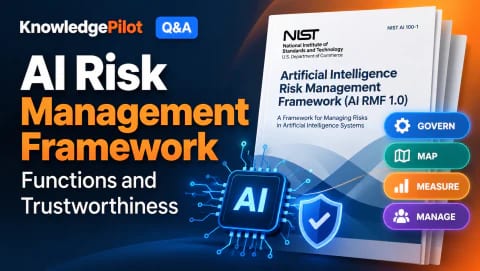
The NIST AI Risk Management Framework 1.0 is a voluntary, use-case agnostic guide for managing AI risks across the lifecycle through the GOVERN, MAP, MEASURE, and MANAGE functions and seven characteristics of trustworthy AI.
Related Articles
Selected from shared tags, topics, entities, and search keywords.
OpenClaw: How an AI Agent Can Work Across Your Computer
Peter Steinberger explains OpenClaw’s creation, naming history and agent-driven development in his February 2026 interview with Lex Fridman.
Read analysisOpenAI Dots and DevDay Updates: AI Agents That Keep Working
OpenAI DevDay launched Dots, AI workers that keep working after you close the app, plus ChatGPT Space, GPT-6.1 Sol, and Codex upgrades.
Read analysisJensen Huang on AI, NVIDIA, Work and the American Dream
Jensen Huang discusses NVIDIA's origins, the AI race, energy and manufacturing, and his immigrant journey in a source-cited conversation with Joe Rogan.
Read analysisOpenAI, Navier-Stokes and the Debate Over AGI Progress
OpenAI reportedly solved the Navier-Stokes Millennium Prize with 10,000 agents in 88 hours. Inside the AGI debate, agent breakouts, and the AI economy.
Read analysis