An annual report tells several stories at once: how management describes the year, what the financial statements report, and which risks or accounting details qualify the headline results. A useful AI summary keeps those layers separate so you can decide where to read more closely.
Use AI to create a factual research brief with source references, a small set of checked figures and a list of unresolved questions. This is a reading workflow, not a valuation method or investment recommendation.
Begin with the right report
Download the report from the company or the relevant filing service. Record the issuer, reporting period, publication date and document version. An investor presentation, annual report and earnings transcript are different sources; label them accordingly.
For US filings, the SEC's guide to reading a 10-K explains the main sections and their purposes. Reporting formats vary across jurisdictions. Use the actual document's contents page rather than assuming every annual report follows the same structure. The SEC reference is linked below.
Write the reporting period at the top of your working note. If you later add an earnings call or a second annual report, label each source separately. A claim from management commentary should not be presented as a number from the audited statements.
Make a map before asking for a verdict
Ask: “Map this report's business overview, operating discussion, risks, financial statements and notes. Identify the reporting period and source locations. Flag missing or unreadable sections.”
Compare the answer with the contents page. Then decide which parts deserve detailed questions. The map prevents an attractive summary of the opening letter from standing in for the full report.
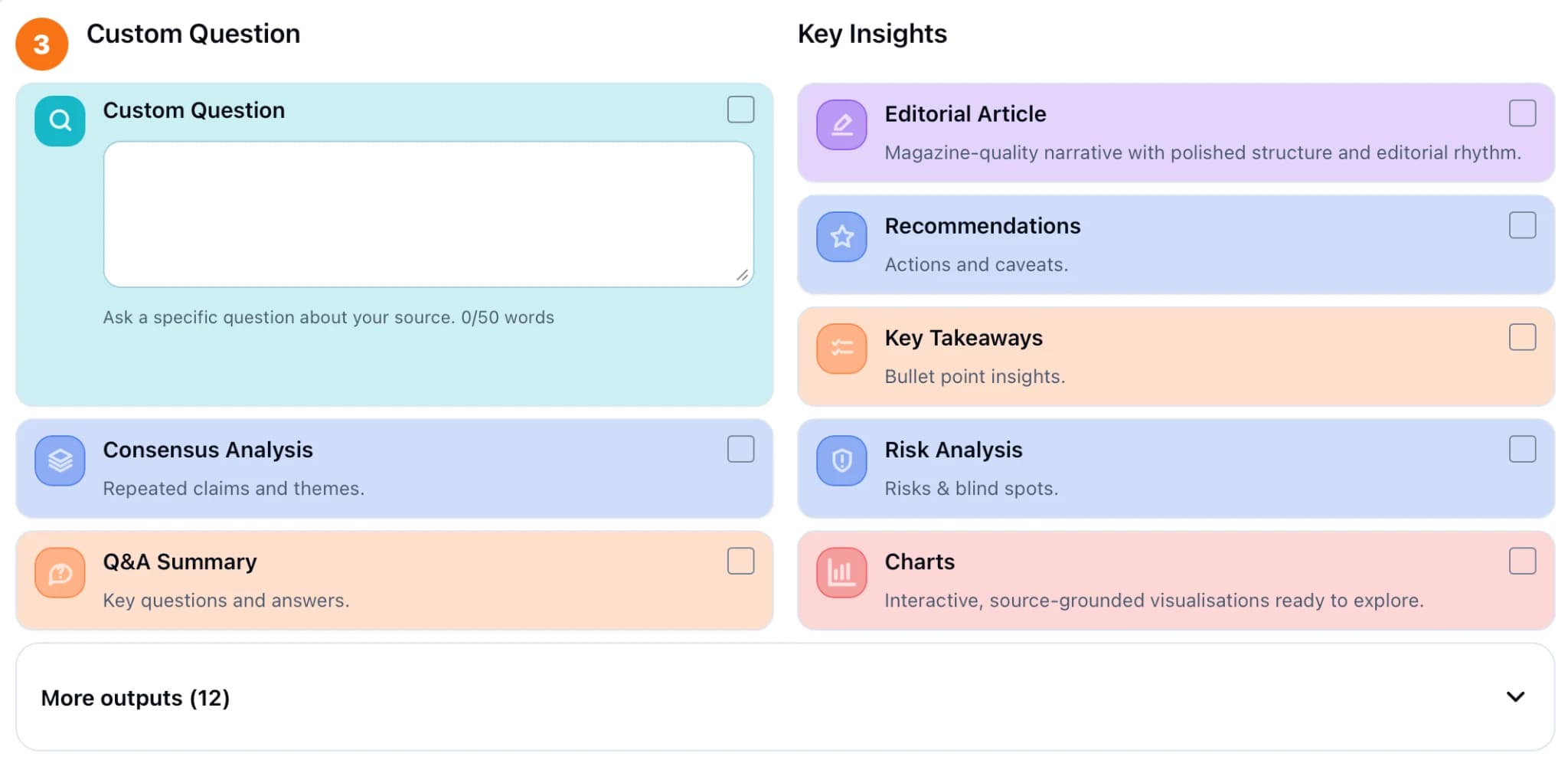
In KnowledgePilot, upload the PDF, confirm the document title, and choose the outputs that serve your research question. The output-selection screen is a useful reminder that a general summary, key takeaways and a focused custom answer serve different jobs.
Build a brief around five questions
| Research question | What to retain |
|---|---|
| How does the company describe its activities? | Business and segment definitions |
| What changed during the year? | Reported figures and management's explanations |
| Which risks are discussed? | Specific disclosures and relevant context |
| How are important measures defined? | Units, periods and adjustments |
| What remains unclear? | Follow-up questions and pages to inspect |
Try: “Create factual notes under these headings. Distinguish reported results, management explanations and forward-looking statements. Cite material points and do not infer an investment recommendation.”
In KnowledgePilot, use the annual-report PDF as your source, choose the relevant outputs and ask focused questions about the disclosures you want to inspect. Available document references help you return to the evidence.
For a concise first pass, request five rows: claim, reported value, period, source location and unresolved qualification. Leave a row blank if the PDF does not establish it. A blank cell is safer than a confident explanation inferred from an adjacent chart.
A worked example: growth is not one interchangeable number
Imagine a fictional report describes revenue growth of 12% and organic growth of 5%. A summary saying “the business grew 12% organically” has combined two different measures.
Your note should retain each measure's label, value, period and definition, then cite its source. Do the same for currency, thousands versus millions, and full-year versus quarterly figures. If a table includes adjusted measures, inspect the accompanying explanation rather than assuming the headline number matches the financial statements.
Treat generated tables as reading aids. Verify the source values before calculating ratios or exporting them into a financial model.
For every figure, check the table heading, units, currency, fiscal period and footnotes in the original report. Then ask whether the sentence summarising it is a reported fact, management's explanation or your own interpretation. Keep those categories visibly separate in the final brief.
Read the notes behind the headline
A summary can locate a figure quickly without explaining everything that affects its interpretation. Follow questions into the relevant accounting note, segment disclosure or risk discussion.
Ask: “Which definitions or qualifications elsewhere in this report affect this statement? Show the supporting passages separately.” If the answer does not establish the relationship, keep it as an open question. Do not let a plausible explanation become a reported fact.
Compare periods without mixing definitions
Keep the prior and current reports clearly labelled. Use the same headings for each and ask for changes in disclosure, wording and definitions, with a reference to both documents.
A new segment name or restated comparison can make a simple year-on-year summary misleading. KnowledgePilot Hubs can bring related retained sources together, but the comparison still needs separate evidence for each period. Record “not directly comparable” when the documents do not support a clean comparison.
One useful follow-up is: “List the metric names or segment definitions that changed between these two reports, with a passage from each period. Do not calculate a growth rate where the definitions differ.” Review the cited notes before deciding whether any apparent change reflects performance, reporting scope or an unresolved question.
Continue with How to Summarize a PDF with AI Using KnowledgePilot, compare the approach with How to Summarize Long YouTube Videos: A Practical AI Workflow, or explore The Honest Guide to NoteGPT Alternatives.
How we help
How KnowledgePilot helps
KnowledgePilot can help map an annual-report PDF, generate selected research outputs and answer focused disclosure questions with available document references. Check every material number, period and qualification in the original report; the workflow is not investment advice.

Frequently asked questions
Can AI analyse financial tables in an annual report?
It can help locate and describe them, but extraction and interpretation can fail. Check the original values, units, periods and definitions before relying on a table or performing calculations.
Is an annual-report summary investment advice?
This workflow organises factual source material. It does not assess suitability, recommend a security or establish its value. Keep research notes separate from investment decisions.
How do I avoid missing important disclosures?
Compare a document map with the contents page, ask targeted questions and inspect relevant notes and limitations. A short summary cannot establish that every important disclosure has been captured.
Leave with a research file, not a stock verdict
Save a concise brief, verified figures and open questions with the original report. KnowledgePilot can help organise the reading and keep available evidence close to the answer, making the next review easier to start.